Showing posts with label Pep Guardiola. Show all posts

Monday, September 26, 2011

Guardiola to close the circle

It was a night of the Spring of 1988, April 28 to be precise. It was FC Barcelona's Night of Long Knives. It is important to set the context. La Quinta del Buitre's Real Madrid is the dictator of La Liga. The madridistas have won two Ligas in a row and the third is in their hands. At the same time, FC Barcelona live moments of total frustration, the memories of the defeat in the European Cup final at Seville against Steaua Bucarest are a heavy weight for a club that feels cursed. The club has just won 2 Ligas since 1960 and the future does not look brilliant. The season is terrible, out of the race for the title, the team sink in La Liga and the coach who took the team to the last Liga title and the European Cup final, Terry Venables, is fired due to the bad results. Luis Aragonés, his replacement, saves the season with a Copa del Rey title which does not hide the big problems of a broken team. In this situation, the night of April 28 1988 the players call the press to expose their disagreement with the club due to a situation created in the trial of Schuster and the club, which exposed the payments of salaries using the image rights, which caused a problem with the tax administration about the nature of these payments. The whole squad, represented by important players like Alexanko, Victor and Gerardo does not accept to assume the costs of the problems of the club with the tax administration and demand the resignation of the president of the club, Josep Lluís Núñez. Only 3 players of the 25 men squad do not sign the manifesto: Gary Lineker, who is travelling with his national team; Bernd Schuster, who is out of the squad and preparing his exit to Real Madrid; and López López.

The president Núñez faces the situation and prepares the revolution. The first step was to sack the coach, who supported the players. The next was to fire 13 players of the team: Amarilla, Calderé, Clos, Cristóbal, Gerardo, Linde, López López, Manolo, Moratalla, Nayim, Pedraza, Schuster and Victor, more than the 50% of the team. The remaining players were Alexanko, Carrasco, Julio Alberto, Lineker, Migueli, Roberto, Salva, Urbano and Zubizarreta. In a matter of two years, only Alexanko and Zubizarreta continued in the club. The president Núñez had "cut the head of the traitors", but the atmosphere in the Camp Nou was very hostile against his management and he needed a big impact to change the negative trend against him. It could only be one person, the last big idol of the club: Johan Cruyff.

Johan Cruyff
In these years of frustration, the figure of Johan Cruyff was important. As it happened in 1973, Johan Cruyff appeared to save the club, a reason (probably the only one) to feel illusion. The Dutch icon started his revolution. The club brought several important players making a huge economic effort to build a new team. Players like Bakero, Begirisitain, López Rekarte, Serna, Unzúe, Julio Salinas, Eusebio, Soler, Aloisio, Valverde and Manolo Hierro join the club.

Since the very first moment, Cruyff does not hesitate one bit to impose his model (or Ajax's model) in Barcelona. Cruyff bets on a revolutionary system in La Liga, a radical and, for some, suicidal 3-4-3 and style based on the ball possession, passing football and always opening the field with wingers. If this was not enough, Cruyff demands that every single team of the football section, since the youngest kids to the B team play under the same model and system. The whole system turned around the figure of the #4, the central midfielder, an anchor man designed to create and not to destroy. For this task, Johan Cruyff made a strong bet for Luis Milla, a player of La Masia who had the required skills to do the job and impressed everyone. The beginnings were not easy. The team struggles during the first season, adapting to such a revolutionary and unknown system. If this was not enough, Real Madrid continues with their dictatorship... adding the former blaugrana idol, Bernd Schuster, to the formula. Despite the difficult moments, the team ends up winning the Cup Winners' Cup at the end of the season.

Luis Milla

The 1989-1990 season had to be decisive. The club satisfies the demands of Cruyff and bring two of his petitions: Ronald Koeman, a central back with talent to play the ball from the back signed from PSV Eindhoven, and Michael Laudrup, a Danish forward who had been considered one of the most important talents of the continent, but had failed in Juventus FC. Johan Cruyff did not move a centimeter from the line he had drawn the previous season and kept insisting in the attacking 3-4-3 and the ball possession. The team keeps suffering to follow an unbeatable Real Madrid and the criticism of the press is furious. Besides, Johan Cruyff decided to separate Luis Milla due to the high salary petitions, which break the new wages structure of the club. With the head of Johan Cruyff in real danger, the victory in Copa del Rey final of 1990 against the powerful Real Madrid saved the season of the team and the position of the coach.

The 3rd season of Johan Cruyff was definitive for him. It was all or none. Hristo Stoichkov signed for the club to reinforce the attack, but the press kept insisting about Luis Milla, who had been essential in the style and the formation of the team on the pitch. Charly Rexach, Cruyff's assistant, made an already mythical comment: "Forget about Milla, we have a kid in the B team who is much better". The new #4 was a 20 year old thin kid: Josep Guardiola. And everything started to work smoothly: Barcelona started to play like the angels, all the criticism disappeared and everyone started to praise the beauty and the style of football of Cruyff's Barcelona. It was the beginning of the most golden era of the club in its history: 4 Ligas and 1 European Cup in 4 years, not forgetting another Cup Winners' Cup and Champions League final in these years. The success and the legendary status of this team changed everything in Barcelona. The club got rid of the nostalgic and cursed feeling to become a self-assured community with a recognizable style. Since 1990, Barcelona had ups and downs, but the club never gave a step back towards the past.

Barcelona's Dream Team at Wembley
There was only one thing that got lost in the way. The 3-4-3 system used in the times of Johan Cruyff by his Dream Team was the only thing that belonged to the past. Even in the most successful moments of Louis Van Gaal and Frank Rijkaard, who also come from the Ajax school, the team never played with this system and "only" kept the ball possession and attacking style. Even during the first three seasons of Pep Guardiola as coach, the 3-4-3 was not even considered a possibility except for eventual and exceptional moments.

But something changed this year. Pep Guardiola insists in one technical aspect: "We must reinvent ourselves year by year". A phrase that easily belongs to Cruyff too. And it is true that last year's Barcelona was similar to the one of his first season, but not exactly the same. New variants have been introduced, like moving Leo Messi from his limited wing to the fake striker position, as Laudrup had done in the early 90s many times, but the basic 4-3-3 was not under question. While everyone was doubting about the way to manage players like Iniesta, Xavi, Cesc Fàbregas and Thiago Alcántara for only two positions, Pep Guardiola had a plan. The reinvention is here: Barcelona goes 20 years backwards and introduces a modernized 3-4-3 system to give these players the space they needed. The message is clear, Xavi, Iniesta and Cesc can play together and Thiago joins the party rotating one of the stars, but getting the minutes he was demanding in his progression. Probably, the arrival of Cesc, who added a more direct style to his Masia DNA, gave Guardiola the solution to reintroduce the 3-4-3 in Barcelona's football.


The players are different (probably even better) to those who were part of the Dream Team and some details difer, but the idea is the same. Villa and Pedro are the modernized version of Stoichkov and Goikoetxea; Messi is as fake striker as Laudrup once was; Cesc is an elitist version of Bakero; Xavi and Iniesta highlight the new gravity point of the team, just where Amor and Eusebio were the diesel engine of Cruyff's Dream Team; and "don't worry about Toure Yaya, we have someone better in the B-team" Sergi Busquets is a more muscular but equally intelligent Guardiola of nowadays.

Josep Guardiola did not forget the 3-4-3, he had never forgotten this system. It was somewhere stored in his memorable mind, in a brain that, since the first day, learnt everything from every single coach he had. Josep Guardiola is not a copy of Johan Cruyff, there are details of every coach who has managed him in his football.  But, Guardiola owes Cruyff a lot and, as good barcelonista and member of the Dream Team, the seed of the master was in the pupil. The circle took 20 years to get almost completed. This Barcelona of records has still one to reach: the 4 consecutive Ligas of the Dream Team.

The frenetic game of Barcelona in Mestalla made everyone see Cruyff's Barcelona again, this infinite search of the goal by the blaugranas mixed with sudden heart-attacking counters of a rival exploding the spaces left by a 3 men back line. This is the reinvention, the tribute to the master and only the victory with the 3-4-3 would definitely close the circle.

Johan Cruyff & Josep Guardiola

Thursday, September 1, 2011

Cesc Fàbregas, Guardiola's wildcard

The story of the signing of Cesc Fàbergas for Barcelona was long. So long that even some sectors of the barcelonisme starting to have doubts, due to the high price demanded by Arsenal and the progression of Thiago Alcántara. Some other fans (I must admit I may belong to this group) were not sure of paying important amounts for a player that had been raised in La Masia, but had decided to leave in a personal decision, since this effort could send a wrong message for the young players of Barça's youth system. At this point, if there is someone who really insisted in this signing, it is Pep Guardiola.

The general opinion was that the signing of Cesc Fàbregas, as good as it would be anyway, was also unnecessary. Barcelona probably count on the most powerful midfield on Earth. Xavi and Andrés Iniesta are World class players and Cesc Fàbregas would be a good complement, but not an urgency. Besides, Thiago Alcántara was there too. The same generalized opinion said that Guardiola wanted him thinking in the mid-long term. With Xavi being 31, Iniesta being 27 and Thiago being 20, Cesc (24 years old) appears as the one who was going to replace Xavi in Barcelona to allow a slow and non dramatic transition, which would also help Thiago to progress on solid grounds.


Cesc joined Barcelona late this summer, so Guardiola could not experiment with him much. But in these weeks, it has been possible to see Cesc in several positions. Not only this, the individual skills of Cesc Fàbregas also allowed Guardiola to try different tactical versions, with the player in different positions. It is true it is not the first time Guardiola make changes in the positions of the players nor used tactical variants, but with Cesc Fàbregas being the wildcard, the possibilities of doing them seem to grow significantly.

Cesc Fàbregas made his debut in the Supercopa against Real Madrid. Barcelona used the classic 4-3-3 formation and, with 10 minutes to go and the 2-2 in the scoreboard, Cesc replaced the winger Pedro, while Iniesta was moved to the fake winger position in order to leave the central midfield for the new #4 of Barcelona to partner Xavi. This is what everyone expected, a natural change, Cesc playing in his natural position and Iniesta moving in order to take advantage of his versatile style. With the 4-3-3, Cesc seems to be the 3rd option for the central midfield, after Xavi and Iniesta. The plan worked for Barcelona, Cesc is deeper in his style, compared with the classic partnership, which was what Barcelona needed at that moment and it worked, since Barça scored in the last minutes with Cesc involved in the creation of the goal.


The first relevant test was in the Gamper trophy, the game of presentation of the team in the Camp Nou. Lionel Messi, usual owner of the #9 position in Barcelona was not part of the initial XI. Until then, it was Villa who used to fill this space, but Villa stayed in his already natural position as left winger. Surprisingly, Cesc Fàbregas was the #9 of Barcelona. It was well known that Fàbregas possess a higher capacity to score goals and appear in the box compared with Xavi and Iniesta, but definitely the position was not natural for him. But, since Guardiola renounced to have a classic #9 to fix the rival's central backs to play with Messi in this position on free role, the Catalan coach wanted to test the possibilities that Fàbregas in this position. And, still knowing it was just a test, it worked. Cesc was the #9, but as Messi, he was given a free role to fall to midfield and help in the creation, which gave Barcelona superiority in midfield and caused chaos in the defense of Napoli, who were chasing shadows, not having a reference to mark.

Last Monday, in the game against Villarreal, Guardiola put his Barcelona in a time machine and proposed the classic 3-4-3 of the Dream Team of the early 90s. Probably, this system is just a consequence of the situation (Barcelona had lots of players injured in defense), but it is also true that Barcelona also needed the right players to do it. Statically, Cesc was placed in front of the two central midfielders and behind Messi, a kind of Italian trequartista, the typical mediapunta, a pure playmaker. But football is also movement and there were 8 field players which had an important discipline at keeping the position, while Cesc joined Messi in the free role style. If Messi himself usually is a disturbing element due to his unpredictable movements, Cesc joined the perfect chaos too, interchanging positions with the Argentinian star or supporting the midfield to create superiority in the creation zone. Villarreal had a 4 back line plus 2 defensive midfielders, but Barcelona opened the field with 2 pure wingers, creating lots of spaces for Messi and Cesc, who were not occupying attacking positions, but appearing in this zone. Barcelona did not packed the attack with forwards. Barcelona created the spaces for the forwards and central midfielders to appear surprising from second and third lines. This is possible because Cesc's skills are more suited to this kind of zone and definitely suited to Barcelona's style. As Messi himself said: "I mix well with Cesc, because we have played together since we were kids".


Guardiola found its wildcard, which adds depth to the team, but also gives the team tactical options that were not so obvious until now. These possibility allow Guardiola to reinvent Barcelona's tactical system again. This is why the already legendary coach of Barcelona wanted Cesc and only Cesc.

Thursday, August 18, 2011

Supercopa: Chapter II


The final chapter of the Supercopa was a memorable game, just as it was the first. As it happened in the Bernabéu, the Camp Nou got dressed as in the important occasions. The match really deserved it. It is just my personal opinion, but nowadays a Barcelona-Real Madrid is the best football game you can watch and it is really difficult to find a similar collection of stars on the pitch. The precedents, the quality of the players, the necessity of beating the eternal rival, all the ingredients suggested that something incredible was about to happen.

The match was unforgettable. The proposal of Real Madrid was brave, at the level of the size of the name and the shirt of this club. But Barcelona also made a step forward after the bad image shown in Madrid. The game was the kind of match that the fans love and the coaches hate. No one really had the game under control in any moment of the 90 minutes. Sometimes the teams lacked the required precision, but despite this fact, both teams made a tribute to football, in a majestic demonstration of quality, effort and skills.


The game was overall balanced, but Real Madrid looked better once more. The pressure, the verticality, the quality of this team seemed endless at moments. And Barcelona responded with heart, attitude and the infinite individual quality of some of their players, essentially Lionel Messi. The Argentinian is the key to understand the outcome of this trophy. Real Madrid have very good reasons to feel frustrated, since they were the best team in most of the 180 minutes of this Supercopa, but they did not find the formula to stop Messi, who led his team to the victory with 2 goals and 1 memorable assist. If we saw a big Real Madrid, we also saw a giant Lionel Messi.

The feeling is that we are going to start a historical season, with two super-teams who will give everything to defeat the rival. The level of competitiveness and tension is so high that there is no room for mercy. There never was, but this time it looks like Barcelona and Madrid are further than ever in history. They feel and probably are the 2 best teams of the World and this Earth is too small for both.


Things can change in two days and, maybe, Real Madrid will find the way to stop Messi soon. They look closer or, as close as they were in the run of tight Clásicos last season. But this time it was very frustrating, because Real Madrid did everything they had to do to win both games, unlike it happened last year, when the madridistas accepted a minor team role. Real Madrid demonstrated they can play face to face against Barcelona. The difference are details. 

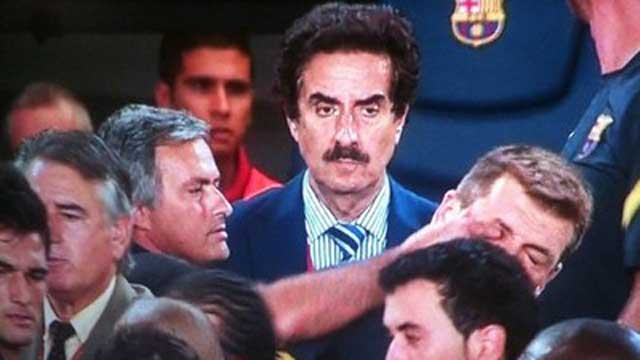
And this is why it is necessary to talk about Jose Mourinho. These Clásicos were already hot behind him, but the outcome of these games are reaching unknown limits. The fights, the press conferences of insults, the fingers in some else's eye, the lack of class of the team disappearing from the pitch when Barcelona was going to get the trophy. It is an unnecessary stain in a sublime game. For Barcelona, the sweetest Supercopa, the first time they win this trophy against Real Madrid, while Pep Guardiola matches the record of Johan Cruyff. A promising season is waiting for us.


Tuesday, August 16, 2011

Supercopa - Chapter I

100 days after the hot run of Clásicos last season, Real Madrid and Barcelona met last Sunday in the Supercopa. Even though a Clásico is always a very important game, from the comments from both sides, it was evident that this is the least important trophy of the season. José Mourinho defined the trophy as the least important of the season, but the most important of the summer. Pep Guardiola announced that his team was short in the preparation, but stating that this fact would never be an excuse and highlighting that the best team will win the trophy. With these precedents, the game was about to start.

But, despite the final outcome of the trophy will not be useful to take conclusions, no one wants to lose against the eternal rival. In fact, the Santiago Bernabéu showed a fantastic image, packed, full of flags and the lungs of the madridismo working at full use since the doors of the stadium opened. José Mourinho presented the model lineup of the previous season, the same lineup that got trashed in the Camp Nou 5-0 last year, forgetting the experiments of the run of Clásicos last year. On the other hand, Pep Guardiola had to do lots of changes in the initial formation of the team. With Puyol still injured and Piqué not in his best conditions, Barcelona did not have any specific central back to face the most effective attacking line of the World. Aside the problems in defense, the main concern was in a midfield that did not have the compass of the team, Xavi Hernández, nor the man that holds the system of the team, Sergio Busquets. Instead, he gave Thiago Alcántara his first chance in a big game and tested Keita as anchor man.


Since the first second of the game, it was evident that Mourinho and his team had forgotten the mean image shown last Spring. Instead of assuming the minor team role, the madridistas wanted to impose their football and their image could not have been better. Real Madrid pressured all over the field, making impossible for Barcelona to connect 3 passes in a row. When the merengues had the ball, their blizkrieg attacks were unstoppable for a shaky Barcelona. Real Madrid only needed 3 passes to put the ball in the danger zone, where the dinamic Benzema and Özil were extremely dangerous. The first dangerous action was a fantastic header by Karim Benzema, which was not a goal because Victor Valdés flew where not many goalkeepers can. But it was evident that Barcelona could not resist that pressure much and a direct ball to the right flank of Real Madrid's attack was taken by Benzema, who toyed with his fellow countryman Eric Abidal and took advantage of the late help of Mascherano to pass the ball between the legs of the Argentinian for Mesut Özil, who executed without mercy. The celebration of the goal said it all, a 90% for Benzema and 10% for the German.

Barcelona was desperate and, given the situation, Guardiola betrayed one of his untouchable commandments. He asked his goalie and defensive line to kick long balls to avoid the pressure of Real Madrid in order to stop losing constant risky balls in dangerous zones. The result was a very strange situation: the ball possession of Real Madrid was higher than Barcelona's. Who would have thought? The defense of Barcelona was shaky, Thiago and Keita were out of the game and Iniesta could not create by himself. The forwards spent more time helping in defense than attacking the rival. The aggressive pressure of Real Madrid was working, despite the tackles of Alonso and, especially, Khedira were sometimes in the border of the rules.

Within the minutes, Real Madrid lowered the level of pressure (it was impossible to keep that rythm for so much time), Ronaldo got lost in individualistic actions, Özil started to disappear from moments and only Benzema kept being a constant danger. But, in one way or another, the game had only one owner: Real Madrid. The relief was not enough for a mediocre Barcelona, who just offered a high dose of attitude to stop Real Madrid.


And, probably the first time Barcelona crossed the midfield in a creative action, the ball ended up in Messi's feet, who attracted several defenders around him. The Argentinian opened the ball to his left flank, where David Villa faced Sergio Ramos. Even though we all saw that action from Villa one million times already, he did it again. Villa cut in and shot the ball to the long post. A piece of art. A fantastic goal that could not have been more unfair, given the game we were all watching. After 35 minutes, it was the first shot of Barcelona... and the result was 1-1. The Bernabeu got quiet, surprised by the tie... and, when the game was about to reach the half time, in a lost and strange action, Leo Messi could escape from several rivals, with a mix of talent and luck, to face Iker Casillas. The Argentinian did not forgive: 1-2. Two shots, two goals. Unbelivable for madridistas and barcelonistas.

The half time was not a solution for a shocked Real Madrid. Quite the opposite, Barcelona enjoyed their best minutes at the beginning of the second half. With more spaces, Thiago started to appear and connect with Iniesta, Alexis started to win all the battles against Marcelo and the 3rd goal of Barcelona was closer than ever. But somehow Barcelona got paid with the same bill. When Madrid was struggling to play their football, a messy action in Barcelona's box after a set piece ended up in Alonso's feet. The Basque midfielder used precision over power and kicked the ball through a forest of legs of Barcelona players. When Valdés saw the ball, it was already in. 2-2 and 35 minutes to play.

Guardiola risked Xavi and Piqué to give the team more stability. On the other hand, the goal of Real Madrid was an impulse for the home team, but the efforts of the madridistas were unefficient, sometimes due to the lack of precision in attack, sometimes due to excessive individualism. A tired Barcelona, without lungs and legs to attack, chose to keep more ball possession to let the minutes pass. The last minutes of the game was a kind of revival of what we saw last year. Possible penalties here and there, Pepe and Alves in their own roles, fights, constant fouls and protests.


The madridismo will probably regret the result, since they were superior, especially in the first half. If they want to see the positive side, they already know that it is very difficult not to succeed next time in similar circumstances. If they want to be negative, they will wonder what they have to do to defeat Barcelona, since it was an impossible task, even in their best day. The barcelonistes have reasons to be worried, the lack of preparation was evident, a big dose of luck (or efficiency) may be enough once against Real Madrid, but they will have to show much more if they want to defeat their rival for the first time in the Supercopa. But, at the same time, the culés must be proud of their attitude and competitiveness, which were high enough to achieve a really good result in the Bernabéu... once more.

The 2-2 gives Barcelona the favorite condition. Real Madrid knows that they will probably have to win in the Camp Nou, if they want to achieve this title. But, looking at the first game, it does not look impossible. A great game in front of us: Chapter II, tomorrow night.

Sunday, July 31, 2011

Thiago Alcántara, blessed problem

You did not need to be a genius to realize that Thiago Alcántara is the player of La Masia with more potential, at least in the short term. He had been amazing everyone since he joined the youth system of Barcelona and it was evident that the kid had all the talent to triumph in football if he kept everything else in the right direction. Aside the talent, Thiago seems to have an infinite ambition. Last year, he started the season with Barcelona Atlètic in Segunda División, but his football was too good for the cathegory and the club was "forced" to make him part of the first team during the season, automatically activating a clause to raise his buyout price in order to avoid surprises, since he already was in the agenda of half Europe. The same ambition that betrayed him when he said that he wanted to triumph in football, not necessarily in Barcelona. Words that forced him to apologize fast... but also the kind of words that made people doubt about his head, since he would not be the first player to lose track in the progression for thinking too high too soon.

At the end of last season, Pep Guardiola set the objectives for this summer and, once again, Cesc Fàbregas was in the list. Many people made a logical interpretation: Xavi is already 31 and will be 32 early next year and, last year, the injuries were hauting him. Despite he did not show signs of decline, it is evident that he will have to start to save efforts pretty soon. Andrés Iniesta is in the peak moment of his career and is Xavi's perfect partner. But then, there was a gap between the fantastic duo and Thiago Alcántara. No one had doubts about his talent, but it was normal to have doubts about the capacity of such a young player to drive the most exigent midfield of the World so soon. Thiago was good, very good, but too young to be compared with the 2 best midfienders of the last years. And this is why, the logical reasoning asked for Cesc, a player with La Masia DNA, experience and leadership skills. It would be perfect for Barcelona and for Thiago's development.


Before the U-21 Euro, Luis Milla, the Spanish NT's coach and someone who knows Johan Cruyff's psychological methods too well said about Thiago: "If Thiago wants to be like Xavi or Cesc, he needs to be humble". A kind of attack on his star, which suggested that Thiago still had a lot to learn, trying to cool all the hype about him. Thiago responded with a magnificent tournament driving Spain to the victory, showing great football. Later on, Thiago joined Barcelona's pre-season and, if there is a name that is shining above the rest is Thiago Alcántara's.

Cesc is not in Barcelona yet and, once more, Thiago is going very fast, jumping stages in his career. With the signing of Cesc to be decided, Thiago is making people have doubts about the necessity of the player of Arsenal, considering the huge amount of money Arsenal is asking for. The debate is in the streets, is Cesc necessary having Thiago in the pocket? When at the end of May, most of the barcelonisme was convinced about Cesc, now things are not that obvious and there is an important sector that defends to give the #4 to Thiago Alcántara... the guy is prepared for it.

There are 2 possible scenarios: If Cesc joins Barcelona, will it be a problem for Thiago? Barcelona would gather 4 fantastic players for 2 or 3 positions (Iniesta can still be a fake winger) and Pep Guardiola would have to drive the situation very well, since it is hard to keep 4 players of very high level happy, if they do not enjoy all the minutes they want. In that situation, it is likely that Thiago would be the one enjoying less minutes and the club already knows the hot mouth of the Spanish-Brazilian player.


The 2nd possible scenario is Cesc staying in London. Then the question that arises is: Is Thiago prepared for the big games? One thing is to shine in pre-season games and a different one is to do it in the important matches of the official season. Xavi and Iniesta had to work and fight a lot to be where they are. In that sense, as much as Thiago is impressive, he also needs to keep in mind that things are not always that easy and sometimes you need to clash against the floor to get up stronger. It is not stupid to think that Thiago still has a lot to learn and do to compare his career with Xavi's and Iniesta's ones... even with Cesc's.

At this point, probably, Thiago is going faster than Pep Guardiola would have thought at the end of May and two possible scenarios seem to open long debates in Can Barça. Guardiola definitely has a problem and he will have to find a solution... but blessed problem!

Tuesday, July 26, 2011

Why Xavi should be the #1

Yesterday, UEFA announced the 3 nominees for their Best Player in Europe Award: Lionel Messi, Cristiano Ronaldo and Xavi Hernández, and the winner will be crowned in the UEFA Gala at the end of August, as always, in Montecarlo. Some months ago, UEFA said that "the new accolade will recognise the best player, irrespective of his nationality, playing for a football club within the territory of a UEFA member association during the previous season. For the inaugural award, players will be judged by their performances during the 2010-2011 campaing in all the competitions, both domestic and international, and at club and national team levels". The jury is formed by 53 journalists, members of the European Sports Media (EMS). Basically, this award is an answer to the FIFA World Player after they merged with France Football's Ballon D'Or and, somehow, wants to fill the space left by the award of the French magazine.

Aside the 3 nominees, UEFA announced the top-10 and there is a fact to highlight: aside Xavi and Messi, FC Barcelona have 2 other players in the top-10, Gerard Piqué and Andrés Iniesta, who was 4th in the votes. So, according to these results, 3 of the 4 best players in Europe play in Pep Guardiola's and the Spanish NT teams. These results do not differ much from the last FIFA World Player Award, which suggests some consensus about the domination of the mentioned teams in their respective tournaments.

Out of the pure facts, I must admit that I am not a big fan of these individual awards. In fact, I believe they are unfair and somehow silly, since I believe football is a collective game, a team game, where the synergies are more important than the pure sum of individuals. Of course, individual talent is important, but it only excels when the collective functioning works as a perfect machine, where the connections, the associations, the flow of a system allows the players to express their natural talent inside the rules and discipline of a system.


Is Xavi better than Messi and Ronaldo? First of all, I believe it is not possible to compare. Lionel Messi and Cristiano Ronaldo probably represent the image of football, they are the best commercial of the game, outstanding players who make the difference when and where it matters. Both are a joy to watch, each one in their own style. No one is going to discover their talent at this point and, of course, if they win any personal award, I would have nothing to say about it. Xavi is not in charge of the electric chair as the other two, his style is more subtle, or just different, impossible to compare.

So why Xavi? Despite I know that these awards are a recognition for the contribution of a particular player in a particular season, I also believe that it is necessary to take some distance and analyze the overall moment. It is evident that Xavi can not compete with the other 2 in terms of goals, highlights or these particular moments that, at the end, are the aspects which make this game be different and attractive. On the other hand, before the goals and the highlights, there is a team, in FC Barcelona, Real Madrid or any other team you can think about. A team that, with their collective performance allows the executioners to excel in what they do.

Looking at the last years, the most successful club has been FC Barcelona. A success based on a certain and maybe unique style of football, which has attracted the attention of the World. At the same time, the Spanish NT won the Euro 2008 and the World Cup 2010, with a different system, but the same idea of football. Basically, we are talking about the most successful teams of their era, in the club and international level respectively. All these teams have something in common: Xavi Hernández.


History will say that, in this era of football, there was a dominant style and, in my opinion, the icon of the style is Xavi. The Catalan player is the engine, the brain and the soul of the teams he plays in. Xavi and his way to view football define the idea of his teams: Barcelona and the Spanish NT. Without Xavi, it would be impossible to understand the success of the dominant teams of this era. Pep Guardiola is not Luis Aragonés and none of them is Vicente Del Bosque and vice versa. The system changes, the mechanisms are different, but the philosophy is the same and the whole idea is built around Xavi.

As extraordinary as they are, Lionel Messi and Cristiano Ronaldo do not define a style, they do not change the teams they are in. They are the best in what they do. They make the difference and they would do it anywhere they would go, but none of them have the influence to change the style. Put it this way, Barcelona and Spain would not be what they are without Xavi. They might be as good as they are nowadays, they might win everything too, but they would be different. Xavi is the key of the idea, everything flows around him, the teams where he plays in build their overall mechanisms and automatic movements around the game of Xavi. If intelligent and patient ball possession is successful, it is because there is a player called Xavi, who reads the game as no one else does nowadays, always choosing the best option, giving the ball backwards instead of losing it or risking an impossible pass, accelerating the pace of the game with a killing assist that breaks 2 defensive lines, but always with an idea in mind: "if the ball is yours, the rival does not have it", which is an idea that breaks the supposed defense and attack border to become an overall idea of football. If the ball is yours, you can score the goals you need... and if the ball is yours, the rival does not have the ball they need to score a goal against you.

Maybe these awards will never recognize the individual achievement of this player, but I believe history will put this Barcelona and this Spanish NT in their right place and Xavi will always be recalled as the architect of their idea of football. I do not believe in personal awards, but I believe in recognition where its due. This is why I believe Xavi should be the #1.