Showing posts with label COPA DEL REY. Show all posts

Saturday, September 24, 2011

The History of the Spanish football (III): 1905-1910, the years of crisis and division

Previous chapter: History of the Spanish football (II): 1900-1905, The first tournaments

In these years, football struggled to survive. The economic crisis in some regions affected the clubs and the tournaments created in the first half of the decade. At the same time, the divisions inside Spanish football started to appear and it had consequences in the newly created tournaments. Still, the game was able to survive and the first steps towards more solid structures were done too.

1905-1906

Campionat de Catalunya

The football in Catalonia fell in deep crisis due to a crisis in the city. Some clubs disappeared and the most important clubs, FC Barcelona and Club Espanyol, struggled to survive. Club Espanyol stop functioning as football club. Miró-Trepat, who was the leader of Club Español, suffered a serious illness and some of their players, who were university students, left the club. As a consequence Español stopped applying to the tournaments. Some of the most important players joined X Sporting Club, a club that was the successor of the already disappeared Irish FC.

In FC Barcelona, the situation was quite similar, although the club did not stop playing games. The amount of members started to decrease for the first time in the history of the club and the team paid the consequences. For the first time, FC Barcelona traveled to Bilbao to play a friendly game against Athletic Club. The Catalans lost the game, 10-1, and the press mocked the blaugranas, current Catalan champions.

Only four clubs applied to the Campionat de Catalunya: FC Barcelona, who defended their crown, FC Internacional, X SC and Català FC. X SC, formed by ex-Español Club players, won the title easily and FC Barcelona was not even a rival for them.

Source: RSSSF Archives

Campeonato de Madrid

The situation in Madrid was not much better. The clubs were struggling to survive and only two clubs played the tournament. Madrid FC faced Internacional del Madrid and won comfortably: 7-0.

Copa del Rey

One more year, the chosen format was a triangular league. Madrid FC were the current winners and represented Madrid and their two rivals were Athletic Club and, for the first time, Recreativo de Huelva, the oldest club of Spain. The Catalans X SC refused to play the tournament due to the economic crisis.

There was some expectation about the presence of Recreativo, since their team was formed by lots of British players, who had some prestige due to their nationality.  The first game was a Madrid FC-Recreativo and the madridistas showed clear superiority, winning 3-0. In the second round, Madrid FC faced Athletic Club, but this time the Basques were not a rival for the madridistas, who beat their rivals (4-1).  Madrid were the winners of this edition and they did not have to wait for the result of the last game, where the Basques of Athletic also beat Recreativo (3-0), who disappointed in this tournament.

Madrid FC, the best team of Spain in 1906

1906-1907

Campionat de Catalunya

The crisis of the Catalan football was evident and only three teams played the competition: X SC, FC Barcelona and Català SC. Internacional FC disappeared too. Some sources consider that this tournament were the roots of the rivalry between FC Barcelona and RCD Espanyol. As it has been already said, X SC was formed by several former Club Español players. The tournament was a close fight for the title between X SC and FC Barcelona.

Both teams had to decide the title in the last game of the tournament. X SC were winning the game (3-2), but the referee decided to add some injury time, since a fight involving two players (Torras, X SC; and Duran, FC Barcelona) ended up in a massive brawl and the police had to intervene, stopping the game for a while. When the final whistle was near, the referee awarded a dangerous foul for the blaugranas. FC Barcelona scored the foul and tied the game, which gave them the title. X SC protested and, the following day, when the referee wrote his report, he decided to revoke his decision, since he considered the protests of X SC, who defended that the injury time was completed when the blaugranas scored their goal. The organization decided to replay the game some days later. This time, X SC won the game (3-1) and, as a consequence, the title.

Source: RSSSF Archives

Campeonato de Madrid

If the Catalan tournament was a mess, the Campeonato de Madrid was not any better. Four teams played the tournament: Madrid FC, Athletic Madrid (current Atlético Madrid), Moncloa FC and Iris FC. This tournament had the first derby between Athletic Madrid and Madrid FC, but all the results were cancelled, since the football pitch did not accomplish with the rules. Madrid FC won the tournament, but the Federation decided to leave a vacant, since the tournament was cancelled.

Copa del Rey

After the failures of the previous editions, the tournament, still organized by Madrid FC, wanted to gather the best clubs of all Spain. Several clubs were invited: X SC, FC Barcelona, Moderno de Guadalajara, Recreativo de Huelva, San Sebastián Recreation Club, Athletic Club, Excelsior Madrid, Hispania de Madrid, Vizcaya Club (gathering players of Athletic and Union Atlética Vizcaína), Hamilton FC from Salamanca and Vigo FC (predecessor of Celta Vigo).

However, the Catalan clubs and San Sebastian Recreation declined the invitation due to their crisis and Moderno de Guadalajara was disqualified by the organization. The clubs of Madrid played among themselves to decide the representative of Madrid and the contest was won by Madrid FC. At the end, only five clubs participated in a league system: Madrid FC; Vizcaya Club, Recreativo Huelva, Hamilton FC and Vigo FC. The teams of Vigo had lots of British players, while Hamilton FC was a team of an Irish school located in Salamanca. All the games were played in five days in the Hipódromo de Madrid.

As Madrid FC and Vizcaya Club (who had the players of Athletic Club) were the main favourites, their clash was supposed to be decisive. The Basque team defeated the madridistas (2-3) in a decisive game, but a couple of days later, Vizcaya Club got surprised by Vigo FC (2-1), who helped the madridistas to tie with the favorites. At the end, Madrid FC and Vizcaya tied in the standings.

Source: RSSSF Archives

Since Madrid FC and Vizcaya Club had tied, there was a replay to decide the winner. The expectations on this game were huge, since the matches between Basques and madridistas were already a classic. 6,000 people showed up at the Hipódromo de Madrid in a record attendance for the tournament. The Basques, who looked more tired, according to the sources, paid the consequences in the second half of the game and their goalkeeper got injured. Madrid FC won the game 1-0 with a goal scored by Prast in the 80'.

The Basques protested to the organization, due to the behavior of the fans, who were very hostile with them. The complaints were not accepted and Madrid FC was declared winner of the tournament. The Basque club declined the invitation the following year as a consequence of this issue.

1907-1908

Campionat de Catalunya

The tournament got a new life this season. Five clubs applied to the competition: X SC, FC Barcelona, Català SC, España FC and AC Galeno (former players of Universitari). At the end, AC Galeno did not play any game. At the same time, for the first time a junior tournament appeared, the Campionat de Juniors.

Despite FC Barcelona reached an all time bottom in terms of amount of socios (only 65 when they had more than 250 before the crisis), the blaugranas were the main rivals of the main favorites, X SC. The tournament was a close fight between the two favorites, which was decided by external events, which made the rivalry of the players of both clubs reach new limits. FC Barcelona was the leader after beating X SC and led the standings until the last game. In the last matchday, España FC and Català SC had to face each other. But España FC did not show up in protest, since they were angry with a federation mainly controlled by X SC. As a consequence of it, all their results should have been cancelled, which would have given the title to FC Barcelona, independently of the result between the blaugranas and X SC. However, Català SC, historical big rivals of the blaugranas protested and the federation only cancelled this last game. As a consequence, the victory of X SC against Barcelona in the last game gave the former players of Español the title for the third time in a row... and the rivalry only kept growing.

Source: RSSSF Archives

Campeonato de Madrid

After the mess of the previous season, for the first time, the Campeonato de Madrid started to work in a more serious way. Madrid FC, Athletic Madrid, Sociedad Gimnástica Española (born from the ashes of Moncloa FC, Hispania de Madrid and Iris FC) and Español de Madrid played a league, following the Catalan model.

The tournament saw a close fight for the title between Madrid FC, Gimnástica and Athletic Madrid. Despite the madridistas defeated Gimnástica in the first game of the tournament, their advantage disappeared when Madrid FC did not show up in their game against Athletic Madrid, who got the victory as a consequence of it. In the return game, Madrid FC won the derby against Athletic Madrid, in what it was the beginning of an eternal rivalry. A draw between Athletic and Gimnástica made the last game decisive. Madrid FC had to visit the home of Gimnástica and the draw was enough for the madridistas (3-3) to win the title, the 3rd for them.

RSSSF Archives

Copa del Rey

The tournament reached an all time low. Madrid FC kept organizing the tournament, but most of the clubs declined the invitation. The Catalans still were in economic crisis and focusing in their own tournament, while Athletic Club did not inscribe in protest for the events of the previous edition. Only Vigo FC, who had won an unofficial tournament in Galicia, accepted the invitation.

The Copa was just a single game between both clubs, played on the muddy pitch of the new stadium of O'Donnell. Madrid FC won the game (2-1), winning the fourth Copa in a row, which was record that has only been matched by Athletic 25 years later.

1908-1909

Campionat de Catalunya

During the summer of 1908, FC Barcelona was about to disappear and Hans Gamper returned in order to rescue the club from the crisis. Gamper started to recover all socios and looked for new members. At the same time, Gamper decided to make a strong bet on the future of the club and projected the first own stadium of the club, L'Estadi del Carrer Indústria, popularly known as L'Escopidora, which eventually held 9,000 fans and was the first stadium to have artificial light. As anecdote, the nickname culés appeared at that time, since from outside the stadium people could see the asses of the fans sitting on the walls of the stadium when the team was playing. At the same time, Julià Claperà and Emili Sampere refunded Club Español as Club Deportivo Español, while X SC, the club that had gathered their players during the 3 years of crisis, disappeared.

In this new edition of the Campionat de Catalunya, there were five clubs: FC Barcelona, CD Español, FC España, Català SC and FC Galeno (formed Universitari). After 3 years of dominance of X SC and their Español players, FC Barcelona went back on track and won the title without having a rival, not losing a single game in the entire tournament, which gave them the ticket to play the Copa del Rey.
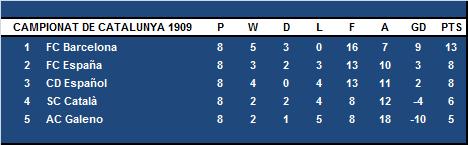
Source: RSSSF and Wikipedia

Campeonato de Madrid

The Campeonato de Madrid kept growing and the four clubs that had played the previous edition repeated their participation this year again. This time it was a league, but only one round played in a neutral stadium. After years of dominance of Madrid FC, there was a change in the hierarchy of the competition. Español de Madrid found no rival in the competition and won the title dominating all their rivals.

Source: RSSSF Archives

Copa del Rey

Madrid FC kept organizing the tournament before the mess that was about to start around this competition, but, since the madridistas did not win the Campeonato de Madrid, they did not play in this competition, although they offered their stadium in the O'Donnell street.

Five different clubs applied to the tournament: Español de Madrid, as winners of Madrid; FC Barcelona, which meant the return of the Catalans of this competition after years of absence; Athletic Club from Bizkaia; Club Ciclista San Sebastián, which was the name of the newly created Sociedad de San Sebastián (who did not play under this name since they did not have the licence to play yet) and Galicia FC, which was a selection of teams of Vigo.

There was a previous round between the two Basque teams and, surprisingly, Club Ciclista defeated Athletic Club (4-2), leaving one of the main favorites out of the competition. In the semifinals, Español de Madrid also surprised everyone by defeating FC Barcelona, the Catalan champions (3-2), and Club Ciclista made their way to the final beating Galicia FC in the 2nd semifinal (2-0).

The final was played under heavy rain between Español de Madrid and Club Ciclista. The reports say that Español de Madrid carried the weight of the team and were the most attacking team, but they clashed against the defense of Club Ciclista. At half time, the result was a 0-1 for the Basques, who extended their advantage in the early minutes of the second half. Despite Español could reduce the advantage of the donostiarras and enjoyed a penalty to tie the game (although it was missed), Club Ciclista scored a goal with 10 minutes to go and won the first title in their history.

Source: RSSSF Archives

1909-1910

Campionat de Catalunya

The Campionat de Catalunya counted on the participation of some new clubs, like Star FC or FC Central, but the second part of the tournament was a complete mess, since several games were not played and there were several administrative solutions to decide the results. In one way or another, FC Barcelona was the owner of the competition without any kind of opposition, winning every single game they played. The blaugranas were back on track thanks to the good management of Hans Gamper, who made possible the future of the club with the construction of the new stadium and his "marketing" skills. Gamper used to finish his speeches with an already classic "Visca FC Barcelona i Visca Catalunya", which made possible to get the attraction of the popular working-class and the industrial middle-class around the club.

Source: Wikipedia + El Mundo Deportivo

Campeonato de Madrid

There is not much information about this edition. The sources claim that the title was won by Madrid FC in a league of 3 clubs, where they faced Gimástica and Español de Madrid. This situation was provoked by the division of the Spanish football in two different factions (more about it in the Copa del Rey part). The winner of the Campeonato de Madrid did not give the ticket for the Copa del Rey, as in previous editions. So there was a game between Español de Madrid and Gimnástica to decide the representative of Madrid. Español won (2-0).

Copa del Rey

1909 was the year of the division. In January 1909 some of the most important clubs of Spain created the Federación Española de Clubes de Fútbol (FECF), which was the direct precedent of the current Spanish FA. The founding clubs were Madrid FC, Vigo Sporting, Deportivo de La Coruña, Cartagena, Circulo Industrial y de Sport de Avilés, Athletic Club, Recreativo de Huelva, Gimnástica and Español de Madrid. Until 1909, the competition had been organized by Madrid FC, aside a couple the exception of the years of the Federación Madrileña de Foot-ball.

But in 1909, Club Ciclista de San Sebastián had won the Copa and made a request to host the games in San Sebastián. Most of the clubs of the FEF rejected this request, since they considered that Madrid was the right place to play the games, given the geographical centrality of the capital of Spain, which saved them costs.

As a consequence, Club Ciclista did not join the FECF and decided to create a tournament by themselves in San Sebastián. Initially, they counted on the participation of 11 clubs that had not joined the FECF, but most of them declined the invitation later on. Finally, two of the members of the FECF decided to travel to San Sebastián. One of them was Athletic Club, who had always defended the petition made by the donostiarras: the finals had to be played in the home of the previous winner. The other club was Madrid FC. In this case, it seems that the decision was influenced by José Berraondo, one of the vice-presidents of the club, who used to live in San Sebastián. In one way or another, Madrid FC had not qualified for the Copa and the club was struggling to survive (some of the players they used in this tournament were players of Gimnástica).

FECF Copa

Despite the initial strength of the FECF, the absences were remarkable and only 3 clubs decided to travel to play the tournament in Madrid: Español de Madrid, FC Barcelona and Deportivo de La Coruña. The organization decided to use a 3 team league in one round. All the games were played in the Tiro de Pichón.

The initial game was played between FC Barcelona and Deportivo. The Catalans, as it had happened in the Catalan tournament, found no opposition and easily defeated the galegos (5-0). The second game was played between Deportivo and the winners of Madrid, Español, who ended up winning the game (1-3).

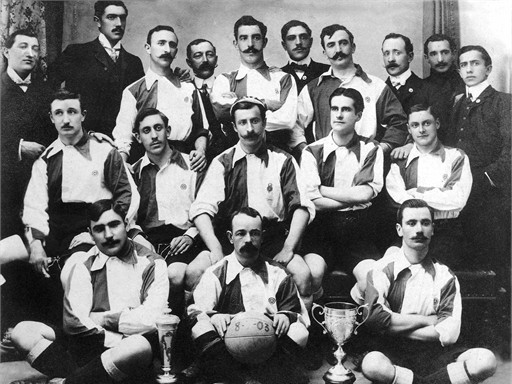
The last game was a "final" between FC Barcelona and Español de Madrid. The españolistas surprised the blaugranas with two early goals scored by Buylla. It was only the 12' and Español de Madrid were 2 goals up, an advantage they kept until the half time. However, the reaction of the Catalans in the second half was impressive. In only 20 minutes, Rodriguez and Comanala tied the game. With 5 minutes to go, Charles Wallace decided the game for FC Barcelona, who won their first Copa title.

FC Barcelona 1910

Torneo de San Sebastián

Ironically, the tournament that had been promoted by Club Ciclista did not count with this club, which had been dismantled after the title of 1909. The football players of this cycling club decided to create an exclusive football club, Sociedad de San Sebastián, but according to the statutes of the Copa, the club was not old enough to play the competition, so they joined a local club called Vasconia Sporting Club to play the competition. Given the importance participants the popular name of the tournament was Torneo de Campeones.

The first game was played by Athletic Club and Madrid FC, a classic already. Athletic won the game against the weakened madridistas. The second game was decisive at the end. The two Basque clubs faced each other. The donostiarras, former players of Club Ciclista, hidden under the Vasconia name, could not stopped their neighbors. Athletic won 2-0 and grabbed the third Copa title of their history. The last game was a meaningless Vasconia SC-Madrid FC, which was won by the local team (2-0).

Athletic Club 1910
Even though some sources claim that this second tournament was organized by a federation called Unión Española de Clubes (UEC), the sources prove that it was not an official tournament. However, the members of the FECF and the dissident clubs signed the peace. The FECF accepted to play the finals out of Madrid in order to keep the union, but this situation was just the beginning of years of tensions.

List of winners

Campionat de Catalunya
1906 - X SC
1907 - X SC
1908 - X SC
1909 - FC Barcelona
1910 - FC Barcelona

Campeonato de Madrid
1906 - Madrid FC
1907 - Cancelled
1908 - Madrid FC
1909 - Club Español Madrid
1910 - Madrid FC

Copa del Rey
1906 - Madrid FC
1907 - Madrid FC
1908 - Madrid FC
1909 - Club Ciclista de San Sebastián
1910 - FC Barcelona (FECF) and Athletic Club (Torneo San Sebastián)

Saturday, September 17, 2011

History of the Spanish football (II): 1900-1905, The first tournaments

Previous chapter: The Origins

The first two decades of the 1900's were the years of the great development of football in Spain. During the last part of the 19th century and in the following years, the football clubs basically were formed by fans of the game, who were at the same time players, managers and directors of the clubs. If football was a game for middle-class university students and foreigners that were importing football from their countries, mainly United Kingdom, everything started to change during these two decades. Football reached the popular classes and the first tournaments and football associations started to appear. These first tournaments were mainly regional, but it also appeared the first national tournament, the Copa del Rey, which was the most important tournament in Spain during the first decades of the 20th century. In this entry, we will refer to the first 5 years of the 1900s, when the first competitions of the Spanish football were born.

1900-1901

Copa Macaya (Campionat de Catalunya)

The first official tournament was the Copa Macaya, which is considered (and accepted officially) as the roots of the future Campionat de Catalunya, and it was played during the first half of the year. Alfons Macaya, honorific president of Hispania AC, one of the clubs of Barcelona, decided to create a tournament using a league system, which ended up having his own name. On paper, it was not meant to be a tournament only for Catalan clubs, but the clubs from Madrid and the Balearic Islands declined the offer due to the big travel expenses in times. At the end, only 6 clubs registered, 5 from Barcelona and 1 from Tarragona: Hispania AC, FC Barcelona, Club Español (nowadays RCD Español), AUF Tarragona, Club Franco-Español and SD Santanach.

The tournament was not exempt of problems, due to the weak base of all the clubs at that point. As a consequence of the poor economic situation, SD Santanach withdrew before the tournament had even started. Later, after 4 games (out of 8), Club Español also withdrew in protest after the game against Hispania AC, since the considered the referees were helping the organizing club. FC Barcelona also made similar complaints, but the club continued until the end. The first edition of the Copa Macaya was a particular fight between Hispania AC and FC Barcelona, which was decided in the last game between these two clubs. Hispania AC only needed a draw in this game to win the trophy and the final 1-1 at home was enough for them.

As anecdote, the first official derby between FC Barcelona and Club Español was played in this tournament and the blaugranas won 4-1 at home, although the relationships between these two clubs was still friendly at that time. There was not a 2nd round, since Club Espanyol retired and their results were not counted.

Source: RSSSF Archives

1901-1902

Copa Macaya (Campionat de Catalunya)

The 2nd edition of the Copa Macaya also counted on five clubs, all of them from Barcelona: Hispania AC (organizer), FC Barcelona, Club Espanyol, Club Universitari and Català SC.

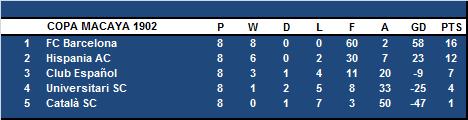
This time there were less polemics about the performance of the referees and the competition was more solid. As it had happened the previous edition, the two favorites were Hispania AC and FC Barcelona, who dominated the whole competition again. Even though the competition kept the league system, the title was decided in the clashes between these two clubs. This time, FC Barcelona were able to have the revenge they were looking for and defeated Hispania AC in the two games, the first one in Hispania AC's home (2-4) and, later in FC Barcelona's home (7-0). FC Barcelona won the 8 games they played in the tournament and AC Hispania only lost the 2 games against Barcelona. This is considered the first official title in FC Barcelona's history.

Source: RSSSF Archives

Copa de la Coronación (Copa del Rey)

In 1902, one of the founders of Sociedad Madrid FC (current Real Madrid CF), Carlos Padrós (Juan Padrós' brother, president of the club), organized a tournament that aimed to bring to Madrid the best football clubs of all Spain, as one of the events of the celebrations of the coronation of the new monarch of Spain, the King Alfonso XIII: the Copa de la Coronación Alfonso XIII - Concurso de Foot-ball del Excelentísimo Ayuntamiento de Madrid, counting on the cooperation of the City Hall of Madrid, which donated the trophy. Carlos Padrós, willing to test his recently founded club, wanted to improve the model of the Copa Macaya, that had recently finished its second edition, and the previous football contests (unofficial) that had been played among the first clubs of Madrid.

Several clubs attended the public announcement. From Madrid registered: Madrid FC and New FC. From the Basque country, Athletic Club and Bilbao FC applied too (although they ended up presenting a combination of the 2 clubs, which ended up merging in 1903, under the name of Vizcaya). Also, all the 5 clubs that had played the last Copa Macaya were invited too, but only FC Barcelona and Club Español applied. However, Català SC and Hispania AC declined the invitation since they could not pay the expenses of the travel, while Universitari SC (only formed by university students) could not register since their members were preparing their tests in the university.

Copa de la Coronación at Athletic's museum
The tournament was played in 3 days using a knock-out system. Since there were 5 clubs, there was a draw to decide the clubs which would had to play a previous round. On May 13, a previous round was played by Vizcaya and Club Español (5-1). The first goal of the tournament was scored by an Español player, Angel Ponz. In the same day, in the first semifinal, the first Clásico of the Spanish football was played and FC Barcelona defeated Madrid FC (3-1) in front of 2,000 fans. On May 14, the 2nd semifinal was played and Vizcaya defeated New FC this time (8-1). On May 15, the first final was played in the Hipódromo de La Castellana by Club Vizcaya de Bilbao and FC Barcelona and the referee was Carlos Padrós. Vizacaya won the game 2-1, thanks to the goals scored by Astorquia (10') and Cazeaux (20'), while the only goal of FC Barcelona was scored in the last minutes of the game by Parsons (75'). Vizcaya (current Athletic Club) is considered the first winner of the Copa del Rey, although this was not the name of the competition until several years later.

On May 16, there was a consolation game with a trophy called Copa de la Gran Peña, which was played by Madrid FC and Club Español, since New FC did not inscribe. Madrid FC won 3-2 and this is considered the first trophy won by Real Madrid CF.

Source: RSSSF Archives

1902-1903

Copa Macaya and Copa Barcelona (Campionat de Catalunya)

Hispania AC kept organizing the Copa Macaya, a trophy that would have ended up in property in the hands of either Hispania AC or FC Barcelona, if they had won the tournament, but this time Club Español surprised them. The league was full of problems since the very first moment. Only 5 clubs applied to the tournament: Hispania AC, FC Barcelona, Club Español, SC Universitari and FC Internacional. Initially, SC Universitary withdrew before the competition had started and FC Barcelona did it too after the organization decided to give them a lost game due to irregular lineup. At the end, it was a triangular trophy between the remaining clubs. AC Hispania and Club Español tied after the 4 games played and the winner was decided in a tie-breaker, which was won by Club Español (3-1) in their first official trophy.

Source: RSSSF Archives

FC Barcelona, who had retired from the Copa Macaya, in disagreement with the organization (Barcelona got a lost game because the organization considered the club had played with an ineligible player), decided to create a new league: the Copa Barcelona. All the clubs of the city of Barcelona were invited, including the ones who were playing the Copa Macaya. Given the important participation and the level of football, this tournament had a relatively high level in Spain. The Copa Barcelona is also considered an official tournament nowadays.

This new trophy counted on the participation of many clubs since FC Barcelona invited all the clubs of the city. So the league initially counted on 11 teams, although 3 of them had to withdraw before the end of the competition. As it was previsible, FC Barcelona, Club Español and Hispania AC were the main favorites to win the tournament. At the end, FC Barcelona won the tournament with a short advantage over Club Español, while Hispania AC was 3rd.

Source: RSSSF Archives

Copa del Rey

Even though the RFEF did not exist yet, this is the first edition of the tournament that officially counts for the Spanish FA, which accepted it as official some years later, even though it did not have this name yet (its real name back then was Concurso Madrid). After the coronation festivals of the previous edition, Carlos Padrós insisted in the idea beyond those festivals and Madrid FC organized the tournament with as an annual event.

Carlos Padrós wanted to invite more clubs and he sent the invitations all over Spain, but clubs like Sporting Vigo, Salamanca, Recreation Huelva (in the future, Recreativo), San Sebástian (Real Sociedad) and, even the runner-ups of the previous edition, FC Barcelona, declined the invitation. At the end, only 3 clubs assisted: Madrid FC as organizer, Athletic Club and Club Español.

The tournament was played in 3 days in a league system. On April 6, Madrid FC and Español played the first game of the tournament and the madridistas won by a comfortable 4-1. The following day was the turn for Athletic Club and Español. The winners of the previous edition did not have problems to defeat the Catalan club either (4-0).

On April 8, Madrid FC and Athletic Club had to play the last game of the league, which was considered a final after all. 5,000 fans went to the Hipódromo de La Castellana to watch the game. The reports of the era relate how intense and passionate was this game. Valdeterrazo (15') advanced the local team in the first minutes of the game. This advantage grew just before half time when Neyra (40') scored the second for Madrid FC. But everything changed in the second half and the goals of Cazeuax (55'), Montejo (60') and De la Sota (80') allowed the Basques to overcome the result. At the full time, Athletic Club 3-2 Madrid FC and the Basques took the cup back home again. The local newspapers said that the game was so emotional that only a few days after this game, Basque students in Madrid founded Athletic Club de Madrid (nowadays, Atlético Madrid).

Athletic Club, Copa winner 1903


Campeonato de Madrid

The same Carlos Padrós had founded the Agrupación Madrileña de Foot-ball and the new regional association created a regional league, following the steps of the Catalan Copa Macaya. In the first edition, the clubs of Madrid that participated in the league were: Moderno FC, Madrid FC, Moncloa FC and Iberia FC.

The first steps were not easy and only 4 games were played (2 games by each club). Despite the league had not actually finished, the Agrupación Madrileña considered Moderno FC the first champion of Madrid.


1903-1904

Campionat de Catalunya

Given the polemics of the previous season, the Copa Macaya and the Copa Barcelona merged into a new league: the Campionat de Catalunya. The organization of the tournament passed from the hands of Hispania AC (which disappeared) and FC Barcelona to the Associació de Clubs de Foot-ball. Even though this league was only played by Catalan teams (10 clubs in its first edition, although one of them withdrew during the competition), it was the most important of Spain along with the Copa del Rey in these years, since it counted on a great tradition and important attendances to the stadiums.

This new tournament only had an owner since the very first moment: Club Español. The españolistas dominated the whole league and only tied one game in the entire tournament. At the same time, there were more changes in the hierarchy of the Catalan football. Hispania AC had disappeared and FC Barcelona struggled to maintain the level of the previous years, with the remarkable loss of Hans Gamper, their founder and best player, who decided to retire to focus in his personal businesses. Other clubs like FC Internacional and the main enemies of FC Barcelona back then, SC Català, emerged in this tournament.

Since AC Hispania disappeared, the ownership of the Copa Macaya trophy was to be given to Club Español, since they had finished above FC Barcelona in the competition. There was also a trophy for the runner-ups, the Copa Torino, won by FC Internacional who defeated SC Català in a tie-breaker game (4-0).

Source: RSSSF Archives

Copa del Rey

For the first time, the tournament was not organized by Madrid FC (who had merged with another club of Madrid, Moderno FC, to be called Madrid-Moderno FC), but by the Federación Madrileña de Foot-ball. The new location was the Tiro de Pichón. According with the rules of the new edition, the regional winners of the Basque Country (Athletic Club) and Catalonia (Club Español) were invited and the Copa winner had to be decided in a triangular tournament with the best team of Madrid.  However, since there was not a regional tournament in Madrid, all the clubs of Madrid were included in the competition.

The whole tournament was a disaster and Club Español withdrew, since they did not agree with the format. As a consequence of it, Athletic Club was exempt until the final, while the other finalist had to be decided among the 4 clubs of Madrid. On March 19, in the first round, Moncloa defeated Iberia (4-0) and Español de Madrid beated Madrid-Moderno FC (5-5), but Madrid-Moderno did not show up in the tie-breaker, which was supposed to play the following day, something against the rules according to the madridistas.

This situation caused a chaos, since the games were delayed. The final was supposed to be played on March 26, but Athletic Club did not find any rival. Still, the semifinal was played on March 27, between Español de Madrid and Moncloa FC. When the game was 1-0 for Español, Hérmua, an Español defender got seriously injured and the game was abandoned with this result. Since the Campeonato de Madrid had been included in this competition, the Español de Madrid was the 2nd winner of the regional tournament.

The organizers fixed the final for March 30, but Athletic Club did not show up, since the final should have been played 4 days before. The Federación Madrileña gave the victory to Español de Madrid, but the rest of the clubs of Madrid (Madrid-Moderno, Moncloa and Iberia) made their protest, since they considered that the final was on March 26 and it was Athletic Club who did not find a rival. It happened that the president of the Federación Madrileña was the president of Español de Madrid too, but they were forced to revoke their initial decision. So Atheltic Club was considered the winner of this trophy for the third time in a row, but this time, they did not even have to play a single game.

Athletic Club in 1904


1904-1905

Campionat de Catalunya

The crisis hit football for the first time and lots of clubs had to disappear, since the clubs were formed by amateur members who could not deal with the big expenses. As a consequence of it, the league was reduced to five clubs: Club Español, FC Barcelona, FC Internacional, SC Català and X SC (formed by old members of the Irish FC).

However, the level of the competition was high and the league was interesting. FC Barcelona won the title after a tight fight with FC Internacional and Club Español.

Source: RSSSF Archives
Campeonato de Madrid

The 3rd edition of this regional tournament was a single game to decide the team of Madrid that would represent the region in the Copa del Rey. Madrid FC won the game and the tournament played against Moncloa FC (2-0), although this game was suspended after 30 minutes, when the players of Moncloa FC abandoned the game.

Copa del Rey

In this edition of the Copa del Rey counted on the participation of two Basque clubs, since San Sebastián Recreation was invited along with Athletic Club. The winner of the Campionat de Catalunya was invited too, but there was not any Catalan club, since their regional tournament, eventually won by FC Barcelona, had not finished when the competition took place.

The format was a triangular league tournament played by Madrid FC, San Sebastián Recreation and Athletic Club (in this case, only 6 players of Athletic traveled to Madrid and the rest of the team was completed by players of their subsidiary club in Madrid, Athletic de Madrid). The first game was played in the Tiro de Pichón by Madrid FC and San Sebastián Recreation. The madridistas defeated the club of Gipuzkoa (3-0) in this opening game. The second game of the competition faced Madrid FC and Athletic Club, the same clubs that had played the final of 1903, but this time the madridistas beated the Basques (1-0). Since Madrid FC won their two games, the madridistas were the Copa winners for the first time in their history.

Athletic Club and San Sebastián Recreation still played their game and it was won by the Gipuzkoanos, but the result remains unknown and it did not have any effect in choosing the winner of the tournament. Other sources claim that this game was never played, since the club of Bizkaia had already left Madrid disappointed by the results.

Madrid FC, Copa winner 1905


List of winners (1900-1905)

Campionat de Catalunya
1901 - Hispania AC
1902 - FC Barcelona
1903 - Club Español (Copa Macaya) and FC Barcelona (Copa Barcelona)
1904 - Club Español
1905 - FC Barcelona

Campeonato de Madrid
1903 - Moderno FC
1904 - Español de Madrid
1905 - Madrid FC

Copa del Rey
1902 - Vizcaya (Athletic Club and Bilbao FC)
1903 - Athletic Club
1904 - Athletic Club
1905 - Madrid FC

Friday, September 9, 2011

History of the Spanish football (I): The Origins

The first news about football (or at least something similar to football) in Spain were documented in 1870. El Progreso de Jerez de la Frontera, a newspaper of Jerez de la Frontera, a town of Cadiz (Andalusia), had a short reference to a cricket game that would be followed by a football game in the afternoon, where the fans could "enjoy banging in a football game". Despite this reference, it is always essential to take a look to the context. Even though the first rules of football, as we know the sport today, were written in 1863 and documented in the sport newspaper "Bells' Life", but the truth was that there were a multitude of rules depending on regions or clubs and the borders between rugby and football were unclear. While some sources claim that the real separation between football and rugby happened in 1871, when the English FA Cup appeared. Looking at the dates and the context, the reference in the newspaper probably talks about rugby-football.

El Progreso de Jerez de la Frontera

How was Spain back then? From the beginning of the 19th century to 1974, Spain had lived the Independence War against the French invasion, which led to a constant fight: absolutists vs liberals. This tense politcal situation was traduced in constant changes in the orientation of the country, civil wars, lack of stability in the different regimes, coup d'etats and the first nationalist tensions. The Spanish economy was based on traditional agriculture; a fragmented, regional and unconnected internal market, the lack of a solid financial institutions and the negative effect of the loss of the American colonies. In this context, the industry in Spain was insignificant compared with the United Kingdom, Germany or the Netherlands and was reduced to very particular zones, like the Basque country (mainly Bilbao) and, especially, Catalonia. The technology used in this industrialization was imported from foreign countries and the first signals of capitalism brought foreign investors, who set their colonies in the cities that were developing an industry and where the raw materials were collected.

One of these zones of raw materials was the province of Huelva (Andalusia), where the copper mines of Riotinto. These mines had been exploited since the ancient times, but during the last part of the 19th century, English investors founded the RTCL (Rio Tinto Company Limited). The Englishmen who worked in the mines did not have much to do in the small town, so they gathered to play their favorite sports, like cricket, rugby and also football. Although the first football games were played in 1873, we had to wait until 1878 until the RTCL formed the Club Inglés (English club) to promote culture, sport and spare time among the workers.

Huelva Recreation Club (Recreativo de Huelva)

In 1884, Dr. Williams Alexander Mackay joined the Club Inglés and created the Sociedad de Juego de Pelota (Ball Game Society), which organized football games along with other typical British sports. The development of this Sociedad is confirmed by a letter sent by Dr. Mackay to the family Dr. Ildefonso Mártinez, where the British man invited the Spansih doctor to join the club to play football and cricket games against the mariners of a merchant ship called "Jane Cory". The date of the letter was March 1st 1888 and the most significant fact is the first reference to a Club de Recreo (Recreation Club).

Dr. Mackay decided to create a sports club in Huelva, the capital of the province. The first meetings of the club was in December 18th 1889 in the Hotel Colón. The meeting was organized by Dr. Mackay along with a German businessman, Wilhem Sundheim, and they invited several personalities of the city like Charles Adams (who was named honor president of the club), J. Crofto, H. Lindermann, A. Lawson, G.M. Speirs, Gout, E.W. Palin and only 2 Spanish: Pedro Soto and José Múñoz. The foundation document was signed on December 23rd 1889: Huelva Recreation Club (nowadays called Recreativo de Huelva) was the first football club to exist in Spain.


The first game of the club was played in February 28th 1890 against members of the Club Inglés of Seville, which was not a sports or football club, but a club with different purposes (culture, spare time). The game was played in the Hipodromo de Tablada, in Seville, and Huelva Recreation Club won 2-0. This match is documented and is considered by the RFEF (Spanish FA), the first game of the history of football in Spain. During all these years, Huelva Recreation Club used to play with the English clubs of other towns like Gibraltar or Riotinto. The club was mostly completed by British players, but 6 of the 19 were Spanish people already.

Athletic Club, the football in Bilbao and the rest of Euskadi

As I already said, football was imported by the British colonies that were based in industrial zones. The first news of football in Bizkaia appeared in 1892, when the president of the Club Athleta de Astilleros del Nervión asked for permission to play in the Hippodrome of Lamiako. Even though the first games were only played by Englishmen, from 1894, the local population joined the game too. They even challenged the British team, losing 5-0.

In 1898, a group of young members of the Gimnásio Zamacois de Bilbao, who were also usual in Lamiako, formed Athletic Club. At the same time, in the year 1900, Bilbao Football Club, founded by Carlos Castellanos in Algorta, a neighborhood of Bilbao. While Athletic Club was mainly formed by local players (only one foreigner), Bilbao FC was mostly completed by foreigners. In these early days of the 20th century, Athletic Club and Bilbao FC joined to play the Copa de la Coronación (current Copa del Rey) under the name of Club Vizcaya de Bilbao, winning the title in the final against a Catalan club, FC Barcelona. In March 1903, Bilbao FC could not keep an independent structure and ended up being absorbed by Athletic Club.

Bizkaia 1902

In Donostia-San Sebastián, the first club was San Sebastián Recreation Club, born in 1903. Six years later, in 1909, the society splitted and the current Sociedad de Fútbol de San Sebastián appeared, although they used the name of Club Ciclista de San Sebastián in some competitions, since the cycling club was registered as official football club and not just as society.

In the rest of Gipuzkoa, the main center of football was Irún, a town located in the Basque coast, in the border with France. The first club to appear was Irún FC (1902), who later changed the name for Irún Sporting Club (1907). An internal division split the team in 1908 and Racing Club Irún appeared. This local rivalry was very strong in such a small town, but the success of these teams was important. Both clubs merged later in 1915.

Another important club that deserve a mention is Arenas FC (later Arenas de Getxo), founded in 1909 and located in Bizkaia, and main threat for the initial Athletic Club.

Catalan Football

Catalonia enjoyed the most developed industry of the country and, of course, there was an important British colony. The first games were documented in 1892 in Can Tunis, a neighborhood of Barcelona, hosted by the Club de Regatas (Boat race club) and were played by Britishmen and Catalan people who had studied in the United Kingdom. In the following years, other games were documented in Reus (Tarragona, South of Catalonia) and some football societies (not registered clubs) appeared in Barcelona. But the first official and registered football club was Palamós FC, founded by Gaspar Matas i Danés in this town of Girona (Costa Brava, North of Catalonia) in 1898.

Football enjoyed a fast and important devolopment in Barcelona, which was living a very dinamic moment, feeling very attracted by the new sport. In the Gimnàs Solé, November 29th 1899, the Swiss Hans Gamper founded FC Barcelona. Hans Gamper had already founded other clubs in his home country and impulsed the sport in his new city too. On December 17, Jaume Vila i Capdevila founded Català SC. As an anecdote, Hans Gamper's initial idea was to join the group of football fans that ended up creating Català SC, but he was rejected for being a foreigner. During the first years of football in Catalonia, FC Barcelona and Català SC had a big rivalry and the polemics about who was the first official club of Barcelona finished when the blaugranas proved that they registered FC Barcelona only a few days before Català SC did.

Hans Gamper (down in the center) and FC Barcelona

Other clubs appeared in the year 1900, like FBC Sant Andreu, founded in 1900 an only Scottish workers, who ended up changing their name for FC Escocés, but they had a very short life. The same group of people founded Hispania AC along with Catalan members of an unofficial team called Team Roig. The main impulse was given by the Catalan Alfons Macaya, who was the president of the club. Hispania AC had a very short life (it disappeared in 1903), but Macaya promoted the Copa Macaya, which was the first tournament ever played in Catalonia and in all Spain. The Copa Macaya is considered the first Campionat de Catalunya.

Also, in the year 1900, a group of Catalan university students registered officially the Sociedad Española de Foot-ball. The founders were Àngel Rodríguez, Octavi Aballí and Lluís Roca, who had been fellow members of the Sociedad Gimnástica Española. The name chosen was restricted by the already existing clubs of the city, which used more representative names. In 1901, before the first Copa Macaya, the club absorbed a smaller team, SD Santanach, and changed their name for Real Club Deportivo Español. The first FC Barcelona-Español (0-0) was marked by the good relationships and FC Barcelona renounced to play with foreigners as courtesy.

Club Español

Other relevant clubs were Universitary Sport Club (1900), founded in the University of Barcelona too; Ibèria SC (1901); FC Internacional (1901), first club of Samitier or Bru; FC España (1905) or CE Europa (1907). The list was endless and clubs appeared and disappeared or merged. In other zones of Catalonia, the development was very important too and historical clubs like Sabadell (1901) belong to this period of time.

Football in Madrid

The development of football in Spain was linked to industrial zones and the coast, zones with higher British influence, but the capital of Spain was an exception in the central regions, thanks to its condition of capital of Spain. The first games were played in the zone of Moncloa, promoted by the Institución Libre de Enseñanza (ILE), an educational and cultural center, which hosted Oxbridge graduates and had a decisive influence in the intellectuals of Spain during the first part of the 20th century

The first club of Madrid was Football Club Sky, founded in 1897, and used to train and play games in Vallecas and Moncola. The club splitted in the year 1900 to disappear, forming two new clubs: New Foot-ball Club de Madrid and Club Español de Madrid. The latter was founded by Julián Palacios who also helped the Catalan brothers Juan and Carlos Padrós in the creation of Sociedad Madrid FC (the current Real Madrid CF) in 1902. Carlos Padrós was fundamental for the development of football and, willing to improve the model of the Catalan Copa Macaya and using as an excuse the coronation of the King Alfonso XIII, impulsed the Copa de la Coronación in 1902 with the help of the City Council. One year later, Carlos Padrós also impulsed the creation of the first federation of clubs in Madrid.

Madrid FC in 1902


In the year 1903, a Basque colony of students lead by Eduardo de Acha met representatives of Athletic Club, one of the clubs of the team Bizkaia that had won the Copa de la Coronación (now Copa del Rey) to create a branch of the club of Bilbao in Madrid: Athletic de Madrid (nowadays, Club Atlético de Madrid). Athletic Club helped Athletic de Madrid since the first moment, giving them uniforms, the badge and the name. In the first years, Athletic de Madrid could not participate in national tournaments due to their link with Athletic Club. Athletic de Madrid got their independence in 1907, when they stopped being a branch of the classic Basque club.

Clubs in Seville

The British colony of Seville introduced football in the city and, as we said in a past entry about the Sevillian rivalry, the first club of the city was Sevilla FC, which was founded in the year 1905. Only a couple of yeas later, Sevilla Balompié was born, a club that was founded by university students. In 1909, internal polemics about the acceptance of working-class players made some members of Sevilla FC leave the institution to create a new club: Betis FC. These three clubs were the most important of the city, until Betis FC and Sevilla Balompié merged and got the "royal" title to create Real Betis Balompié in 1914. The rivalry in Seville is a strong as it was back in the first decades of football.


Valencian football

In the Valencian region, the first news of football belong to the year 1900, in the coast town of Santa Pola, where some British researchers placed their residence to study an eclipse. At the same time, it is well known that the three important harbors of the region (Grao in Castelló, Malvarrosa in València and Puerto de Alicante in Alacant) used to receive merchant ships from the United Kingdom with Britishmen who organized games in these cities.

In València, the mariners neighborhoods (Cabanyal, Malvarrosa and Port de Sagunt) were the location of the first teams of the city. In this way, unofficial societies like Universitario FC (roots of Gimnástico FC), Club Valencia, Gimàstic FC or Club Marítimo (precedent of Levante UD) were born in 1902. Later on, in 1905, Valencia FC (no relation with the current Valencia CF, which was posterior in time) was born too, probably being the most important club of the city in this decade, although it did not have much continuity.

El Cabanyal at València

In Alacant, the first football society was Sportsman's Club Lucentino in 1904 and very soon other clubs, like Racing FC, Mercurio or Alicante Recreation Club (who ended up merging with Sportsman's Club Lucentino in 1909), joined them and their matches were usual in the city, also travelling to Valencia and Murcia to play games in different events.

In Castelló, the first clubs belong to the 1910's, when CD Cervantes and CD Castalia appeared and were the roots of the future CD Castellón.

Unlike other regions, the first couple of decades lacked stability due to the weak institutional support and, in all three provinces, clubs appeared and disappeared. The Valencian federation was born in 1909, but the first regional tournaments had to wait until the end of the following decade, so the development of football in these areas was slower compared with other regions.


In the rest of Spain, the development of the game depended on external influences and location, but football definitely enjoyed the acceptance and support of the masses since the very first days. As a consequence of it, the first competitions appeared, like the Copa Macaya in Catalonia as a main reference of other regional tournaments that appeared all around the country. The winners of these tournaments used to play the Copa del Rey later, the only and most important trophy of Spain until La Liga appeared 3 decades later. We will talk about the regional competitions and the first decades of the Copa del Rey soon.


Sources: cihefe.es, wikipedia.com, Hemeroteca El Mundo Deportivo at elmundodeportivo.es 

Wednesday, April 20, 2011

Sergio Ramos y la Copa del Rey.


20.04.2011 - Hay quién dice que la Copa le queda grande o le pesa demasiado a este Real Madrid. Ahí venía Sergio Ramos, Copa en mano (15 kg), hacia la Cibeles a reunirse con la afición cuando... tuvimos que agregarlo a nuestra galería de contratapas...


.

Real Madrid campeón de la Copa del Rey.


20.04.2011 - Con gol de Cristiano Ronaldo en el primer tiempo de alargue (´102), Real Madrid venció (1-0) a Barcelona y se llevó la Copa del Rey en su edición 108. Copa nº 18 de los merengues (después de 18 años) y 12º de Mourinho (primera en España).

"No hay favoritos en una final. Ya jugué varias y siempre han sido equilibradas", dijo Mourinho como si saliera al campo de juego con pantalones cortos e ignorara que todas las casas de apuestas pagaban menos por el Barcelona.

Sin embargo, el Barça se encontró sorprendido en Mestalla. Un Madrid "con el cuchillo entre los deintes" salió concentrado a apretarlo en todo sector y, a través de un desgaste superlativo, interrumpió el conocido circuito catalán.

El Barça no podía hilvanar y el Madrid, a puro vértigo y destrucción, se acercó con más peligro (a mojar y replegarse).

Así estuvo dado. El tiki tiki catalán exige el adelantamiento de todas sus líneas y Mourinho estableció el puro contraataque apostando al pelotazo y a la velocidad de Cristiano Ronaldo (en finos off sides) con Ozil de estación.


El segundo tiempo volvió a tomar un color habitual. Barcelona tomó posesión de pelota (70%) y el Madrid se opuso (casi con juego nulo). Y el Barça, en monólogo, no lastimó.

Y llegó el alargue. Por lo visto (el dominio blaugrana del 2º tiempo y el enorme desgaste del Madrid) podía conjeturarse que todo apuntaba hacia la hegemonía culé. Sinembargo "el carácter y la fuerza psicológica y física de los jugadores fueron determinantes en el alargue." (Mourinho). 

Un encuentro claro: un azulgrana hervíboro versus un merengue carnívoro, un catalán que propone versus un madridista que interrumpe, la pausa culé versus el vértigo blanco, un Barça que salió a jugar un partido versus un Madrid que salió a jugar una final. 


Cristiano Ronaldo, en el minuto 102 (1º tiempo de alargue) le dio el título a Real Madrid.


Barcelona: Pinto, Alves, Piqué, Mascherano, Adriano (Maxwell, m.119), Xavi, Busquets (Keita, m.108), Iniesta, Pedro, Messi y Villa (Afellay, m.105).

Real Madrid: Casillas, Arbeloa, Sergio Ramos, Carvalho (Garay, m.119), Marcelo, Pepe, Xavi Alonso, Khedira (Granero, m.104), Ozil (Adebayor, m.70), Cristiano Ronaldo y Di María.

Gol: 0-1, m.102: Cristiano Ronaldo cabecea un centro de Di María.
Árbitro: Alberto Undiano Mallenco (Comité Navarro). Estadio: Mestalla (Valencia).


.

Tuesday, April 19, 2011

Real Madrid - Barcelona en vivo: Copa del Rey.


20.04.2011 - Se va la segunda... Real Madrid ahora enfrenta a Barcelona en Mestalla (Valencia) para definir, 21 años después, la Copa del Rey en su edición 108. Dice Cruyff que "Mou" "no es entrenador de fútbol, pero sí de títulos, porque es listo". Dice Menotti que "están los que apuestan a jugar bien siempre, como el Barça y los que juegan mal con tal de ganar, como el Madrid". Mientras Adidas ya adelantó la final y Víctor Hugo se prepara para transmitir en vivo por Cadena Ser.

VER EN VIVO
OPCIÓN 3
OPCION 4 (Canal 1 es HD, canal 2 y canal 3)
.

Monday, April 18, 2011

Adidas previene la final de la Copa del Rey.


18.04.2011 - El calendario se confabuló y no deja demasiado tiempo para explotar publicitariamente los cuatro enfrentamientos que, en 18 días, se dan entre Real Madrid y Barcelona.

Ya pasado el primero de los duelos (Liga, 1-1), en el marco de su campaña Is all in, Adidas adelanta la final de la Copa del Rey (miércoles 20 de abril en Mestalla, Valencia).


.

Wednesday, January 26, 2011

Copa del Rey: Barcelona 5 Almería 0.


26.01.2011 - La revelación de la Copa del Rey 2011, el Almería, venía ganando todos los partidos del torneo y saliendo de la cola de la Liga hasta que viajó a Barcelona. Mejoró la performance respecto del duelo anterior (Barcelona le hizo 8-0) pero…

Messi (´10 y ´16), Villa (´11), Pedro (´31) y Keyta (´87) hicieron el 5-0  (ver goles) con que Barcelona (casi) se asegura el pase a la (esperada) final del torneo.

Por la otra llave, Sevilla cayó de local con Real Madrid (golazo de Benzema) y comienzan a abrirse las apuestas para una vibrante final, el 20 de abril en Mestalla (Valencia).
.

Wednesday, January 12, 2011

Copa del Rey: Barcelona 5 Betis 0.


12.01.2011 - Por los cuartos de final de la Copa del Rey, Barcelona venció a Betis (5-0) en lo que fue el estreno del Balón de Oro de Lionel Messi que marcó un nuevo hat trick (el tercero más rápido de su carrera, en 29 minutos; su récord lo estableció el 06.04.2010 vs Arsenal, en 21 minutos).

Pedro (´75) y Keita (´82) cerraron la cuenta antes de que Messi fuera ovacionado de pie al ser reemplazado por Jeffren (´85). Así, las dudas de cimbronazos anímicos en el plantel quedaron más que disipadas y el Barcelona de Guardiola, que marcó 5 (o más) goles en 22 de los 152 partidos que jugó (14%) sigue su carrera triunfal igualando su mejor racha de 27 partidos sin perder (26 de Liga y 1 de UEFA) de la temporada 73-74 (20V 7E).


Las quejas y lágrimas de prensa sobre el veredicto FIFA (Balón de Oro) empieza a formar parte de un pasado anecdótico (Xavi, Iniesta y Messi fueron reconocidos en la previa) al momento en que Messi (23), ahora con 158 goles en el Barça, iguala la marca de Escolá para compartir el 4º puesto en la tabla de goleadores históricos culés.


.