Showing posts with label Manuel Pellegrini. Show all posts

Monday, August 22, 2011

The rise and rise of Villarreal CF

Not so long ago, Villarreal CF was just one more club of a small town of Spain, which used to fight for humble goals in non-professional divisions. Today, this club is in the doors of the new edition of the UEFA Champions League and will fight to overcome the 1-0 defeat against Odense to be among the best clubs of Europe again. How is it possible to grow so much in such a short time?

Vila-real is a town of the province of Castelló, in the North of the Valencian region, 8 Km. far from the capital of the province, Castelló, and 64 Km. far from València, the capital of the region. Vila-real has always been an agricultural town, famous for their oranges and other citric fruits. In the last part of the 20th century, the glaze ceramic industry and other complementary activities developed and, nowadays, the town, with nearly 50,000 inhabitants, is the most important center of this industry in Spain and one of the most powerful in Europe.

The club, which was officially founded in the year 1923, has historically been in humble regional non-professional divisions, except for a short period of 2 years in the early 70s, when they earned a place in Segunda Divisón. Villarreal was just a town club for the inhabitants of the city, with a space suffocated by much more classic and traditional teams of their zone of influence, like Castellón, Valencia or Levante. In the 1990s, Villarreal CF, who had been playing in regional divisions during 2 more decades, returned to the Silver cathegory, until the club was bought by a prominent businessman called Fernando Roig.


Fernando Roig
Fernando Roig is one of the most important businessman of the glaze ceramic industry and he had been also having a sport adventure with the Valencian basketball team, Pamesa Valencia, whose sponsor was the company he owned. In the year 1997-1998, Roig took the club from Segunda División to Primera División for the first time ever in the history of the club. The first visit to the most important division was short and they got relegated in their first season, which was normal, given the lack of tradition and economic power of the club. Still, the come back did not wait too long and they only needed one more year to go back to Primera División in the 2000/2001 season. No one would have thought that the Primera División had just found one of the powers of the decade. A man had a dream and made it real.

Their first years in the division had up and downs. The main goal of the club was to grow on solid grounds, going step by step in the growth, improving year by year, but keeping the economy healthy, unlike other clubs, who started a race of signings and big expenses that nowadays are paid. During the first years in Primera División, the humble club was managed by Victor Muñoz and Benito Floro, managers with experience in the cathegory, which achieved their goal: the permanence in the division.

The turning point was the 2003/2004 season. During the last couple of years, Fernando Roig had been building his squad slowly. Some players were rejections from other clubs, like Pepe Reina, signed from Barcelona; or José Mari, signed from AC Milan. Some others showed that the club had started to build a good net of scouting in South America, and players like Belletti, Battaglia or Palermo (very unlucky with a terrible injury) had joined the club. In the summer of 2003, Villarreal added the last important pieces with the signings of a veteran but efficient Sonny Anderson, the AC Milan rejection Fabricio Coloccini and, especially, the main player of the project that was about to start, Juan Román Riquelme, for only 5M from Barcelona.
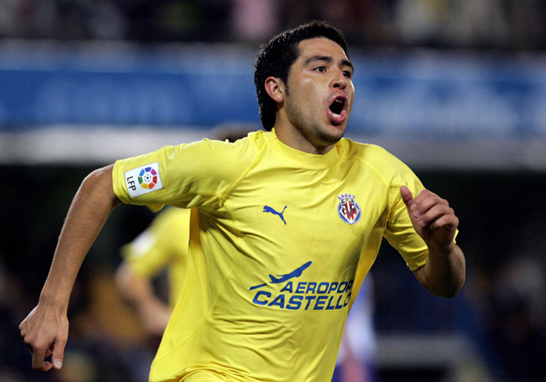


Juan Román Riquelme
The season was not brilliant. The team had earned their place in the UEFA Cup, thanks to the victory in the already dead Intertoto Cup, but Benito Floro decided to resign in February due to the lack of commitment of the players. At that point, Paquito, a man of the club, took the team and raised the spirit of the team to place them in the 8th position of La Liga, near the European spots. But the main achievement was in the UEFA Cup. The team had eliminated clubs like the Russian Torpedo Moscow or the Turkish Galatasaray, but in Spring, they surprised everyone by kicking out of the competition one of the most important clubs of Europe, AS Roma, and later doing the same with another classic, Celtic FC, who had eliminated FC Barcelona in the previous round.

In the first time Villarreal CF played the European competition, they reached the semifinals, where they meet the future Liga champion, Benitez's Valencia CF. Sadly for the Yellow Submarine, their historical season ended up there and the Valencian derby in Europe was decided by a goal of Mista in Mestalla, in a very tight game. Valencia CF ended up winning the UEFA Cup that season.

With the arrival of Manuel Pellegrini in the following season, the project got more solid. The Chilean coach had a prestigious career in South America, mainly in Chile and Argentina, but was very unknown in Europe. Along with Pellegrini, and following the same policy in the market, the club signed a Manchester United rejection, Diego Forlán. On paper an irrelevant signing, given the bad statistics (and even reputation) of the Uruguayan player, but the striker was the Pichichi (top scorer) of the competition and his duo with Riquelme was legendary, taking the club to the 3rd position of La Liga, an unbelievable achievement for this club, reaching the quarter finals in the UEFA Cup again.


Diego Forlán
But the club did not stop there, the (cheap again) additions of Sorín, Barbosa and Senna, covered the exit of important players like Reina and Belletti. The Liga season was not as great as the previous one (they ended up 7th and out of Europe), but the effort and good football of Villarreal got the admiral of all Europe, reaching the semifinals of the competition playing against rivals like Benfica, Lille or Manchester United in the group stage and Rangers or Internazionale FC in their way to this round. Villarreal was very near the semis and only a penalty missed by Juan Román Riquelme in the last minute of the second leg prevented Villarreal to play an extra time that could have given them the ticket to an UEFA Champions League final, which would have been historical, for the club and for the competition.

The next season (2006/2007) was marked by the problems with Juan Román Riquelme, who was forcing his transfer to Boca Juniors. The club had a really bad first half of the season, flirting with relegation spots, but Fernando Roig gave all the support to the coach Pellegrini. The exit of Riquelme in Winter and the adaption of good players like Gonzalo Rodriguez, Nihat and Pires, and the usual goals of Forlán allowed the team to finish in the 5th position, getting an UEFA Cup spot.

Another historical season was the 2007/2008. Good team players like Joan Capdevila and Cani were signed and a veteran John Dahl Tomasson and a young Giuseppe Rossi were signed for a low price to replace Forlán, who had been sold to Atlético Madrid. The team made a fantastic season, being the runner-up in La Liga over FC Barcelona, being the main threat for the champion Real Madrid during a long part of the season. In the UEFA Cup, the initially surprising elimination against Zenit was not that surprising when the Russians ended up winning the competition.


Manuel Pellegrini
The following season kept Villarreal in European positions, Joseba Llorente signed to replace Tomasson, although the core of the team was pretty much the same. The club paid the efforts of playing in two exigent competitions like Liga and Champions League. The club ended up 5th in La Liga and was eliminated by Arsenal in the quarter finals of the UEFA Champions League. Manuel Pellegrini announced his departure in the summer of 2009, when he joined the new project Florentino Pérez in Real Madrid. During the last 2 seasons, Villarreal has been showing consistency, doing decent performances in Europe and better domestic tournaments. Last year, they qualified for the previous round of the UEFA Champions League once more.

All these achievements have its roots in two main blocks: the intelligent investment made in the market by Fernando Roig and the scouting work in South America. Fernando Roig's obsession has always been the economic and financial health of the club. He always knew it was useless to overspend, since the price to pay some time later is even worse. In that sense, Villarreal always had a good eye to catch talent at a very low price, either signing veteran but commited players or rejections from big clubs who still wanted to prove their value. Aside some exceptional cases, the results are there and players like Anderson, Riquelme, Forlan, Sorin, Tomasson, Pires or Reina had a great influence in the achievements of this club. At the same time, the scouting work of the club in South America, which allowed them to bring players like Belletti, Gonzalo Rodriguez, Cáceres, Arruabarrena, Guille Franco or Valencia, has also been a key of the success of the club. In both cases, most of these players triumphed in the club and most who left have allowed the club to recover their investment multiplied by higher amounts. In this sense, Villarreal CF has been one of the most intelligent clubs in Europe in recent years.


Ciudad Deportiva del Villarreal CF
But Fernando Roig knows that the future of the club can not depend only in the good eye in the market. Fernando Roig's dream is to build a project that is there to stay. In 2002, Villarreal CF opened a huge Ciudad Deportiva of 70,000 square meters, where the club owns 5 football pitches, 3 of them with natural grass, and several camps for football-7 or other kind of facilities for the youngest generations. At the same time, learning from and following the example of the most important youth academies, the Ciudad Deportiva has facilities that host 90 young players of different ages (14 to 18 years old) to give them the appropriate environment to grow, with a residence; a library and study room with teachers; a gym; hydro-massage room and all the required equipment. The results are evident, Villarreal "B" passed from Regional (5th cathegory in Spain) to Segunda División in less than 10 years. The academy assures the future of Villarreal, either giving home talent to the team or assuring transfers to other clubs that keep funding the whole structure. An academy that, probably, only FC Barcelona surpass in Spain and not many in Europe.

Villarreal's building have an extremely solid base. Fernando Roig and his right hand Llaneza assure calm and good management, offering the public one of the most attractive and powerful teams of the continent.  Villarreal CF is an example of business, an example of how things must be done. Seriousness, hard work, solid investments, long-term strategy and short-term good decisions, calm to deal with problems. Most of the players who have played in Villarreal admit that the club does not have the pressure of the big teams, but they also highlight how beautiful is to work in this kind of club. What once was the small team of a small town nowadays fight face to face with the most important and legendary Valencian team, Valencia CF, and definitely is one of the references in the World of football among the humble clubs. This week they face Odense in the second leg of the previous round of the UEFA Champions League and they have to overcome the painful 1-0 of the first leg. But, at this point, nothing would be a miracle in that small town of Castelló: Vila-real. I can only wish them the best, because this club definitely deserves more beautiful nights of football.

Saturday, July 30, 2011

When the ball rolls, the Sheikh should be Manuel Pellegrini

In June 2010, the Sheikh Abdullah bin Nasser bin Abdullah Al Ahmed Al Thani came from Qatar to Málaga to buy the club of the city from Lorenzo Sanz for 36M euros. At that moment, not many people knew him and the arrival of the Sheikh Abdullah made the local fans swim between skepticism and illusion. The Qatari Sheikh did not have much time to start his first project, which was put in the hands of Jesualdo Ferreira, successful former Porto coach, who was unable to put the team in the right direction in a mix of incompetence and the lack of good players. The new rich Málaga was flirting with relegation positions and, in November, the Sheikh finally decided to give the step forward the club needed.


Fernando Sanz, ex-president and the Sheikh's assistant, recommended the signing of Manuel Pellegrini, who was unemployed since the moment he was fired from Real Madrid by Florentino Pérez. At the same time, the club made important investments in the Winter market, signing experienced players like Enzo Maresca, Martín Demichelis and Julio Baptista and young talent like Ignacio Camacho or Sergio Asenjo (on loan). The face of the team had a radical change and found the regularity they needed to save the season.

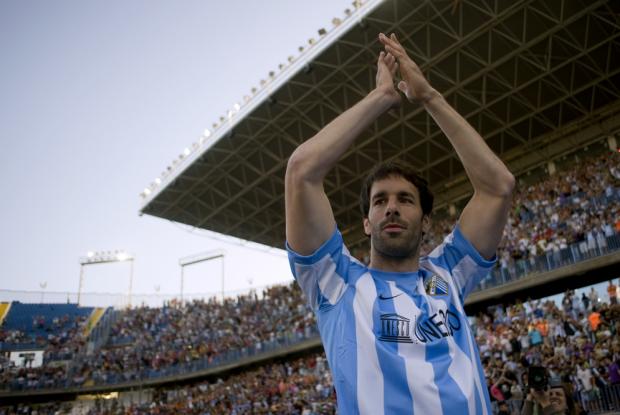
This summer the Sheikh Abdullah has decided that he wants to put Málaga in the top positions of La Liga and, in order to do it, he did not hesitate to invest whatever it takes to change the horizon of the club. At this point of the season, Málaga spent more money in signings than Real Madrid and Barcelona. Everything started with the arrival of Pichichi Ruud Van Nistelrooy for free. Well, not impressive, no one denies the quality of the Dutch striker, but it is not that he is in the peak of his career. The signing had the effect they probably expected though and 10,000 people went to the presentation of the player and the selling of ticket season started to work well. The 2nd one was Ignacio Monreal, Osasuna's full back for 6M, international player and one of the best in his position. The next to come were Jerémy Toulalan from Lyon for 10M, Joris Mathijsen from Hamburg for 1M, Diego Buonanotte from the relegated River and Sergio Sanchez from Sevilla. Every single presentation was a party in Málaga, with thousands of people in the stands of La Rosaleda to welcome their new idols. The state of euphoria was declared... and the Sheikh announced that the best was yet to come.


And they did not hesitate to pay the 6M buyout clause of Isco, the best prospect of Valencia's youth system, which was an earthquake in the Ché club. But Málaga had not stopped fishing in Valencia and they also brough Joaquín Sánchez, the veteran winger who seems to keep his old prestige... 15,000 were in his presentation. But if there is a player who definitely attracts the attention of everyone is Santi Cazorla, one of the best midfielders of La Liga, signed from the Champions League Villarreal for 20M euros, giving him a star contract of 3M euros per year.

For now, it's just a description of facts. But the season starts in a couple of weeks and I always had doubts about this kind of projects. For now it's a bubble of names. All of them sound good. Some of them are in the decline of their careers, like Van Nistelrooy or Joaquín, but overall the club seems to have the right names to do an important season. In that sense, the exigences are going to be high. But this is not always that easy, since it always takes time to adapt and learn the mechanism of a system and a idea. Lots of new faces and not much time, since everyone will ask for good results since the very first day in a team that is not used to fight for important goals. Europe is a must and, given the level of investment, the Champions League should be the objective in a near future... if not this season, the next. It would not be the first time that a huge project like this one fall, so it is important to keep the feet on the ground and be patient.


In my opinion, the key of the project is not the big names, but Manuel Pellegrini. The Engineer is a good coach with high prestige in Spain, a man who knows La Liga and the job, coherent and humble in his work. In Villarreal, Fernando Roig gave him time and stability and we all recall the semifinals of the Champions League of 2006, when the Yellow Sumbarine were a penalty away from the final of Paris. I am skeptical about the results in the short term. As I said, big names do not assure success. Yes, they are important, but it is also essential to set a solid ground to grow from. Manuel Pellegrini is the right man to do it, but we still do not know how the Sheikh and the fans will react if the results are not as good as they expect in the first games.

We must keep in mind that the rivals of Málaga have solid and long term projects, like the ones of Valencia, Villarreal or Athletic, or teams that are used to be in top positions, like Sevilla or Atlético. It is not going to be that easy. The Sheikh must be patient, the fans must remember where they come from. If they do it, I will start to believe in it. But if they get blind for the money they spent, the whole project may end up being a boomerang that slaps them in the face. The Sheikh did what he had to do, but now he must give a step backwards and let Pellegrini work, with time, without pressure... in that case, I will be a believer too. For now, I declare myself skeptical.